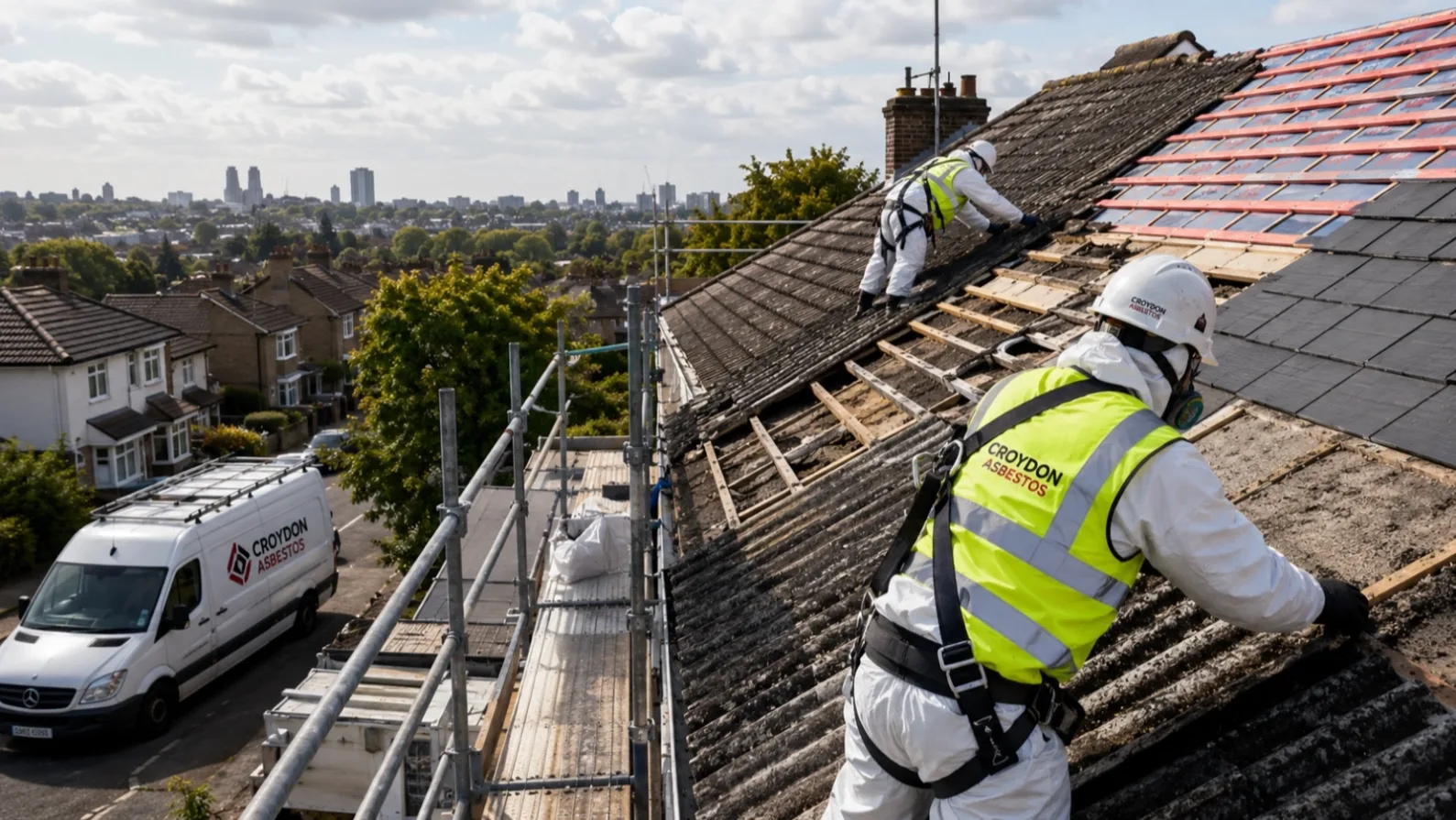
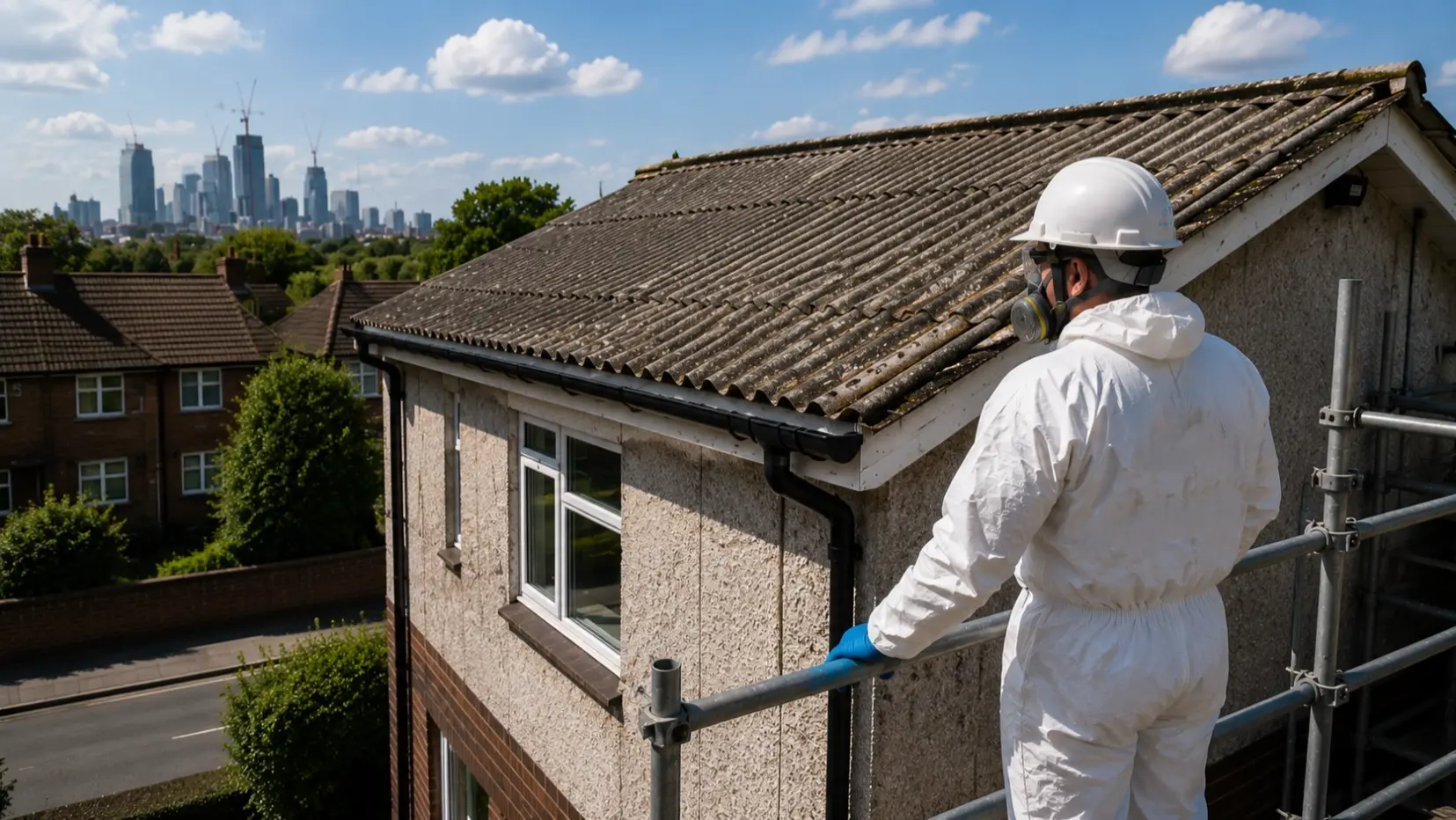
One of the most common questions we get goes something like this: “Can you tell from photos whether this is asbestos?” The honest answer is: sometimes, but not reliably. Visual identification gets you a suspicion. A lab sample gets you a fact. Here’s why even experienced eyes can’t always be certain.
What asbestos cement is
Asbestos cement is Portland cement reinforced with asbestos fibres. It was used from roughly the 1920s through to 1999, when asbestos was banned in the UK. In its heyday it went into corrugated roofing sheets, flat soffit boards, rainwater goods, flue pipes, wall cladding panels and more.
The asbestos content was mixed into the cement slurry during manufacturing, which means the fibres are locked inside the matrix. Intact asbestos cement is considered lower risk for exactly this reason; the fibres only release when the material is cut, drilled, broken or significantly weathered.
What modern fibre cement is
From the 1980s onwards, manufacturers began replacing asbestos with other fibres; cellulose, glass and synthetic materials. The result performs similarly and is used for the same applications: roofing, cladding, soffit boards and more. The manufacturing process is virtually identical to the old one, which is why the visual result is also virtually identical. Both materials are grey, dense and rigid. Both weather the same way. Even the weight and the sound of tapping on them is similar.
Why age is the most useful indicator
Some people will say you can identify asbestos cement by a specific shade of grey, or by certain product markings. Occasionally that’s true, and certain product types are strongly associated with particular eras. But these are clues, not confirmations.
Age is the most reliable guide. If the material was installed before 2000, it should be presumed to contain asbestos until a lab sample says otherwise. That’s not overcaution ; it’s the approach the regulations are built around. Many buildings constructed after 1980 still used existing asbestos cement stocks before switching to fibre cement alternatives, so the cutoff isn’t as clean as people assume.
What a lab sample actually involves
A small sample is taken from an inconspicuous edge by a trained operative, then submitted to a UKAS-accredited laboratory for analysis under polarised light microscopy. The result confirms whether asbestos fibres are present and, if so, which type. Turnaround is typically a few working days, with priority options available when a renovation or exchange deadline is waiting.
The sampling process is low-risk when done correctly. The exposure risk comes from dry breaking or grinding the material ; not from a controlled sample taken carefully at the edge.
The practical rule
If the material predates 2000 and you’re about to disturb it, get it sampled first. It’s inexpensive, quick, and gives you a definitive written answer that a visual inspection never can. If it comes back clear, proceed with confidence. If it contains asbestos, you know exactly what you’re dealing with and can get a fixed price for the right removal method.