Croydon’s listed stock: Victorian churches, Edwardian civic buildings and interwar landmarks spent the twentieth century being heated and “modernised.” That’s when the asbestos went in: lagging in basements, AIB behind panelling, coatings over lath and plaster.


We plan heritage removals to satisfy both regimes: surveys recording historic fabric alongside hazardous materials, methods protecting plasterwork and joinery, and documentation conservation officers and the HSE both accept.
Hand removal, enclosures, reversible
Architects, conservation officers, church bodies
From dual-lens survey to documented handover, every step is planned to satisfy both the HSE and the conservation officer before a single fixing comes out.
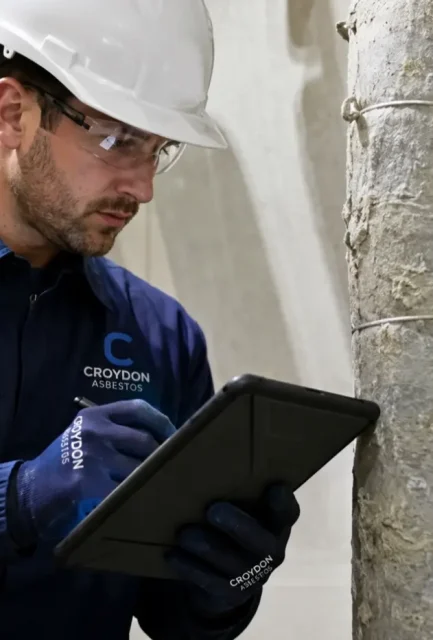
Materials identified and scored with historic fabric mapped alongside; so the removal plan knows what it must protect, not just what it must remove.

Method statements detailing protection, access and reinstatement, written to support listed building consent applications where the works require them.

Hand techniques, surgical enclosures and protection regimes that treat a Victorian cornice with the same seriousness as the fibre count.

Clearances, consignment notes and a photographic record of protected fabric; the file your conservation officer, insurer and congregation all want to see.
HSE compliance never used as an excuse for heritage vandalism, or vice versa.
Operatives briefed on what must survive the job, not just what must leave it.
Conservation officers, diocesan bodies and heritage architects spoken to in their own language.
Where material is safest managed in place within historic fabric, that's the written advice.
FAQS
Sometimes. Removing a freestanding cement tank is one thing; stripping a coating bonded to historic plaster is another. The test is whether works affect the building’s special character; we’ll flag the question early and our method statement supports the application where consent is needed.
Yes. Where material is sound, undisturbed and removal would damage significant fabric, managing in place under a monitored plan is often the correct answer under both regimes. It’s a legitimate outcome, documented properly, not a dodge.
Layered, reversible protection; localised enclosures rather than blanket sheeting where fabric is fragile; hand methods over mechanical ones; and reinstatement planned before the first fixing comes out. Slower, more deliberate; and the only defensible way.
With a survey and a conversation involving your architect early. Crypt lagging is typically licensed-category work needing careful enclosure design around monuments and fabric; entirely deliverable, best planned without a deadline breathing on it.
More care means more hours, so heritage work carries a premium; but a proportionate one, fixed in writing like everything else. The genuinely expensive route is standard-method removal followed by conservation repairs and a difficult conversation with the council.
Preferred, not just possible. Early collaboration produces the method statement, the consent case and the programme in one pass. We slot into your professional team rather than around it.
The statutory consent question differs, but our method doesn’t. Fabric-sensitive techniques and conservation-aware documentation apply wherever the building’s character matters, listed or not.
A method statement detailing protection, access and reinstatement, photographic fabric records before and after, and completion documentation showing the works matched the method. Written to support the consent file, not to survive it.
Yes. From the Old Palace quarter’s ancient fabric to Victorian churches and Edwardian civic stock across the districts, plus heritage buildings on the borders where custodians want the same dual-regime care.
Questions about a job or a quote? Email the team directly.
[email protected]
Speak to a surveyor, not a call handler.
Sales
07798 984290
Support / Enquiries
07468 437558
2 Park Rd
Guildford GU1 4PH
United Kingdom
CONTACT US
Send us your postcode and a description of the material you’ve found. A surveyor will be with you the same week, and your fixed written price follows within 48 hours.
